
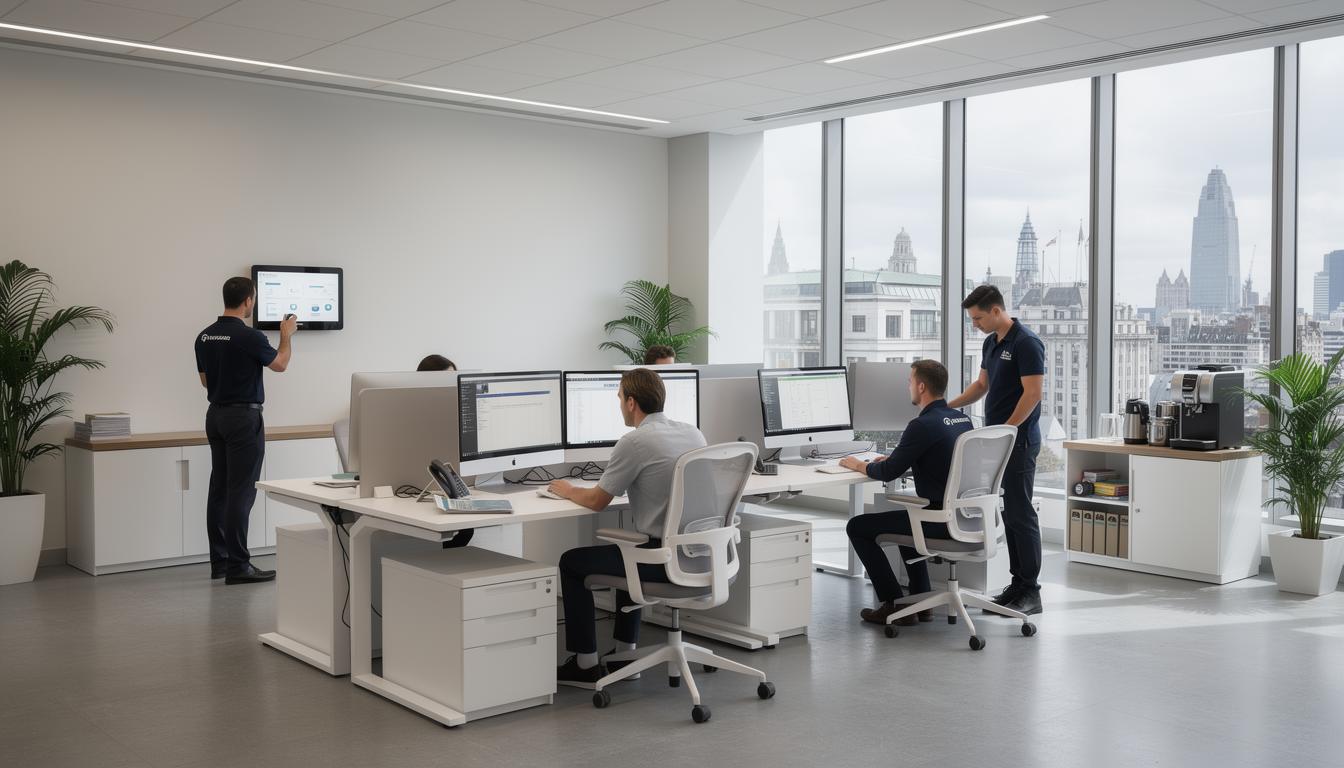
London, that fast-paced city with glass towers stretching high, never gives a second chance. Sky-high rents, rules twisting at every corner, and the day never ends. Offices, a complex dance, solutions must align immediately or everything stumbles. This piece will talk about how smoothing operations, anticipating issues before they grow teeth, and smart support spin headaches into relief. Serenity and results, not just more chores—decidedly not just cleaning a desk or emptying bins. Solved puzzles, less stress, higher returns, and every move counted. Facilities Management London transforms the city’s overloaded spaces, turning burdens into functioning assets and supporting business growth with factual results.
The importance of Facilities Management in London
Londons business core never pauses, not for a second. Stress here, palpable even behind thick glass. Urban momentum, always marching, triggers dizzying expenses. Spaces, narrow or vast, command every ounce of attention, and compliance never takes a day off. Safety standards, endless paperwork—every single cubic meter measured, every cubic meter under scrutiny. No one longs for a penalty or surprise inspection. Prestige at work? Only the beginning. Regulations overheat daily routine. A marathon, sometimes joyless, sometimes thrilling, but always demanding. Managing these requirements, technology, and shifting standards, facilities managers hold the balance, pivoting between comfort, prestige, and utility, seeking not just survival but excellence for every stakeholder.
A lire aussi : What Are the Benefits of Unattended Cremation Services for Families Today?
Complexity rises with each new skyscraper, but also historic brick, aging and beautiful, needing as much attention as those sparkling new towers.
Regulations, strong and unyielding, have shaped habits in every office. Talk about the Health and Safety at Work Act, or CLGs mountain of documentation. That pursuit of sustainable, ‘Grade A’ certification pushes everyone to innovate—emissions lower, operational costs shrinking, staff morale climbing. Facilities support in London blends vigilance, technical skill, curiosity, and a touch of pride in results, never an afterthought. Comfort always sits alongside compliance, a partnership as old as the city itself.
En parallèle : Stylish juliet balconies in cheddar: maximize light and space
The business context and local challenges
Call to mind those spotless West End offices, the shimmering City lobbies, nothing out of place, almost surgical. Regulatory demands take no prisoners. Competition takes root in every office block. Space itself becomes territory—squeezed, scrutinized, held tight—while rivals compete not just for talent or clients but cutting operational waste and energy draw. Premium workspaces? Dazzling on the surface, pressurized beneath. With every energy deadline, every new sustainable regulation, tension ratchets up. London’s property arena never quite calms.
Change circles relentlessly. Compliance, cost pressure, sustainability: a relentless current, always pushing.
By 2026, the rush for net zero boils over. Businesses contend with expectations beyond last year’s blueprints—low-carbon upgrades, new building technologies, and green waste targets become standard. Facilities management never rests on what worked last year. Weekend protests, tricky leasehold clauses, unplanned office pop-ups and, suddenly, teams stretch to adapt. Every property decision, every maintenance call, gets judged in the bold light of competition and public scrutiny. Clients, neighbors, regulators—all want answers.
The core functions of Facilities Management London
Nothing operates by accident. No detail too small: from polished floors to unseen air filters, every fix, every adjustment, measured for impact. Support in London, always broader than repairs. HVAC humming quietly, stairwells never cluttered, response teams, cleaning, maintenance techs tuning services carefully—postcode-by-postcode, era-by-era.
| Key Service | London Focus | Why It Matters |
|---|---|---|
| Building maintenance and repairs | Specialist teams nurture both heritage brickwork and sleek new glass | Reduces disruptions, strengthens insurance claims, preserves assets |
| Security and access control | Contemporary gatekeeping, CCTV, and trained reception match up with policing strategy | Secures property, soothes tenants, frustrates intruders |
| Cleaning and environmental services | Green cleaning routines, visible daytime teams, clever waste handling | Keeps environments immaculate, uplifts wellbeing, boosts image |
| Compliance, health and safety | Ongoing audits for evolving rules, streamlined digital logs | Sidesteps fines, limits hazards, simplifies compliance |
Facilities support is about foresight, not just patching the walls. Ventilation managed, noise controlled, local quirks understood. Top teams work quietly through weather emergencies, city disruptions, staff absence, even annual festive chaos. Staff, residents, even outsiders feel the difference. The property, suddenly, functions as more than just a box; it slips into a business continuity plan, ensuring resilience against the next unexpected shock.
The advantages of Facilities Management in London for businesses
Anyone tempted by patchwork solutions faces disappointment, predictably. Only organized support plans convert stress into reliability, and stealth savings accumulate. Outcomes? Immediate and measurable, not a theory or distant future.
The efficiency and cost savings won with Facilities Management London
London: the city coaxing out every coin. A sharp support system transforms overheads into levers for growth. Fixtures, lighting, security, all digitally monitored—less waste, more foresight. Energy bills shrink each quarter, and LED upgrades, motion-activated devices, centralize control with relentless precision. Maintenance pre-empts crisis—broken lifts, watery leaks, sudden heat loss tackled before the first complaint. The apocalypse of a meeting room flood or power cut? Quietly averted with routine checks. Even those sticky utility contracts, often overlooked, get squeezed for discounts.
British Council for Offices data (2026) notices some London businesses shed over a fifth of operational costs after reevaluating facilities support. Smoother budgets, less drama at month end. The phrase cost-effective building management? Not just jargon, but reality for those who invest in intelligent support.
Predictability returns, panic retreats. Overheads reshaped, profits preserved, and resources redirected toward more energizing goals. The city, for once, aligns with ambition, not against it.
The compliance and risk management benefits
| Compliance Area | Facilities Service | Business Benefit |
|---|---|---|
| Fire safety | Routine evacuation exercises, equipment checks, clear exit routes | No litigation, improved standing with insurers |
| Accessibility | Accessible entries, gate maintenance, serviced lifts | Upholds Equality Act, burns brighter reputation |
| Environmental reporting | Regular waste tracking, carbon dashboard | Audits pass with ease, less money vanishes in landfill fees |
Box-ticking, for some, conjures bureaucracy. Truth? Assuring safety and compliance halts disaster in its tracks. Neglect brings risk; caution builds confidence. Digital reporting, routine signage updates, automated logs—all slip quietly into daily flow. Health and Safety Executive reports for 2026 show penalties rising. The viral scandal no one plans for? Kept at bay. Strong facilities management swallows risk, leaving businesses to breathe, with regulation handled by experts.
One HR leader at a Covent Garden tech firm stated, “Our absenteeism has plummeted. Facilities management, once a hidden expense, actually brightened morale and freed management to focus.”
The impact on employee experience and productivity
Clear windows, green plants, climate in check—staff notice the details. Workplace support exceeds just wiping dust. Background sound, light levels adjusted, no-stress facilities. Productivity soars, staff stay healthy, unexpected repairs do not drain anyone’s attention. Strong management treats space as an engine for wellness—not just a container for desks. Retention improves, staff stay longer, fewer recruitment headaches. Workplace experience management? No longer a boast but a differentiator, felt by every department. The buzz of a cared-for environment, that shared sense of belonging lifts the whole atmosphere.
The criteria for selecting a Facilities Management provider in London
Expertise divides calm from disarray. A provider’s local footprint, their record against London’s standards, and their adaptability—all matter.
The essential qualities and certifications that count
| Certification or Quality | What It Proves | Why It Matters in London |
|---|---|---|
| ISO 9001 or 14001 | Tested operational quality and careful approach to sustainability | Works in step with the city’s green priorities, ensures consistency |
| IWFM membership | Current expertise, community recognition, ethics | Access to recent trends, peer evaluation with a London bias |
| SafeContractor | Health and safety verified at every stage | Reflects strong risk controls, matches client safety benchmarks |
Certifications, far from a box-ticking exercise, draw a bright line between robust and unreliable. Check the record, not just the badge. Run through client reviews, hunt for recent projects, seek nuance in references. Industry bodies screen out unreliable players. Client feedback exposes truths that no marketing blurb uncovers.
The steps in the procurement process
No mystique, just careful groundwork. First: specify building quirks, from ventilation rates to parcel delivery security. Then scan for providers blending local knowledge and global practice, because size alone never guarantees agility. Reviewing proposals means dissecting every contract—supplies, response times, clarity. The onboarding stage? Measure everything: from shared KPIs to dashboards and check-ins. This lays the foundation for a relationship that endures tough times. Honest talks in the early days sweep away missteps later. Open dialogue, less pain down the line.
- Energy efficiency upgrades frequently reduce monthly bills
- Effective cleaning regimes have improved workplace health indices
- Certifications like BREEAM or WELL now impact occupancy rates
- Tenant queries, resolved rapidly, often lead to better relations
The future of Facilities Management London
Change flows in, inevitable as rain over the Thames. Yesterday’s aspiration, today’s requirement, tomorrow’s routine. The city takes the lead, not content to copy.
The role of technology and sustainability in Facilities Management London
No more waiting for innovation to land. IoT sensors evolve, occupancy tracked without fuss, ventilation rebalanced before problems arise. Sustainability grows roots: green rooftops increase, harvested water swirls into pipes, and live dashboards track every kilowatt. Benchmarks—BREEAM, LEED, WELL—take on real significance. Proptech’s effects ripple from the smallest upgrade. A light sensor, calibrated and aligned, shifts how people feel, how budgets behave, even how buildings are valued.
The case studies of London businesses leading with Facilities Management
Beyond numbers, daily reality shifts, office by office. A mid-sized business settled into London Bridge, regulation fears and cost spikes coloring every staff meeting. Outsourced facilities leadership reset priorities—safety metrics rose, energy bills dropped by almost a fifth in twelve months. A law office in the Square Mile, tired of rising bills, installed smart metering and flexible lighting—their annual electricity spend dropped, freeing budget for staff development. A listed structure near Parliament, working with a firm versed in heritage, saw disruptions decrease, audit success rise, and no restoration ever knocked operations sideways. One facilities coordinator notes, “Now, chaos no longer dominates Mondays. More time for strategy, fewer lost hours in crisis. Our building finally works for our business.”
Ambition, compliance, peace of mind—all interconnected. The right support refashions challenges into proof of progress. If those walls could talk, some would already be asking, what difference would it make if your building finally served you, not the other way round?